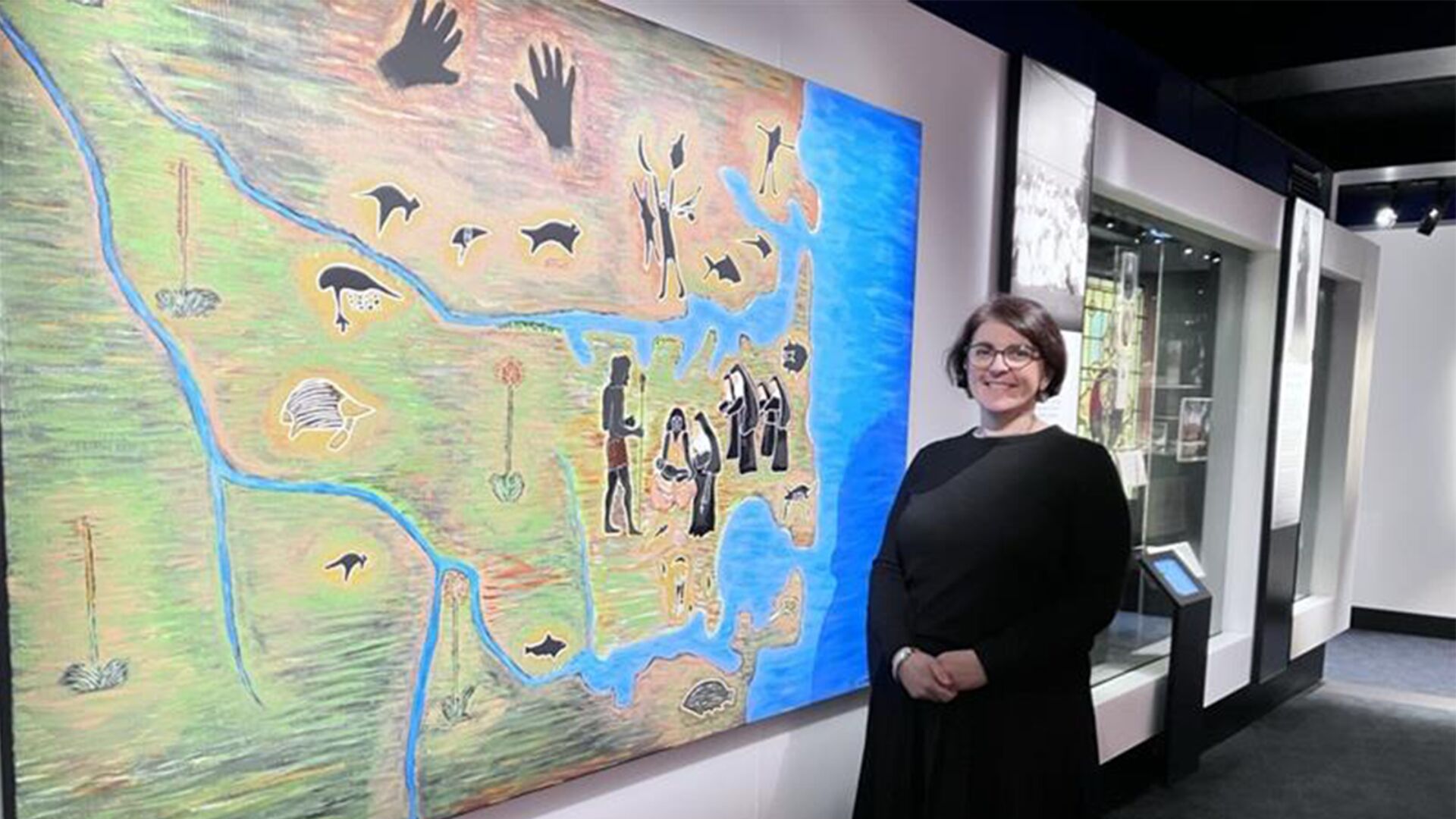
Can you please introduce yourself and tell me a little bit more about this place?
My name is Danielle Achikian, and I look after the Sisters of Charity Heritage Centre here in Potts Point (NSW). The Heritage Centre tells the Australian story of the Sisters of Charity, who were the first religious women to come to Australia in 1838. They’ve done a huge amount of work and innovation in the areas of health, education, and other ministries.
Why do you think it’s important to continue this legacy and have this place?
The impact of the Sisters’ work has been so significant, and it’s a story not well known. The Sisters were always focused on being of service to the poor, not focusing on self-promotion, that is why many Australians aren’t familiar with their story. They lay the foundations for many institutions we know today, such as St Vincent’s Hospital and the Garvan Institute. Now that fewer Sisters are involved and laypeople are carrying on the ministries, it’s important that the history and legacy is shared and we feel part of this living story, part of the Church’s mission.
The Heritage Centre is a living story, and everyone who walks through the door is part of it. It’s a story about women’s resilience, courage, creativity and empowerment in the service of the people of God, which is something we talk about a lot today.
Can you give some concrete examples of how these women were strong, and how they can inspire us today?
The founder of the Sisters of Charity, Mary Aikenhead, was an Irish woman, born in the 18th century, who started the congregation to serve the Irish poor. Like other congregations, the Sisters took the three vows of poverty, chastity, and obedience, but they also took a fourth vow: service of the poor.
That vow has guided their work from the very beginning. The first five women who came to Australia were women of great courage. So, when we talk about empowerment, the words that recur in their story are courage, resilience, and innovation.
They were risk-takers. They worked within a male hierarchy. In 1838, they came as Irish Catholic women to an English colony. That took enormous courage. But from the start, they had the support of the local community.
When they bought their first house Tarmons here in Potts Point, the community rallied around them and helped pay for it. It was a large sum at the time, and contributions covered the cost. The person selling them the house even donated £1,000 towards the purchase.
And that empowerment carried across two centuries, to starting hospitals, schools, investing in research, caring for AIDS patients when very little was known about it, and investigating the setting up of safe injecting rooms. These were bold and, at times, controversial steps.
There was apprehension and fear, of course. But they took the risk, for their future and for others. The establishment of Mary Aikenhead Ministries, the Public Juridic Person governed by lay trustees for the continuation of ministries, is one example of how they took charge of their own future and legacy. The Heritage Centre is one way they’ve ensured the story continues.
From early on, they were very committed to empowering women and girls, establishing girls’ schools, vocational colleges, encouraging participation in sport, science, the arts. You can see this in the history of the schools where they worked. They empowered girls to have careers.
As someone active in the Church today, how important is it for you to continue empowering every individual?
I like to think we’re empowering all people, especially to consider serving the marginalised, the disenfranchised.
I believe there’s room for a diversity of views and for a welcoming, joyful spirit in the Church. If nothing else, I hope this place, on behalf of the Sisters, is one of hospitality and inclusivity. We don’t turn anyone away. Whether someone comes to see the permanent collection, a temporary exhibition, or just for a coffee and a chat about the Sisters' story, they are welcome.
Empowerment means people feel they belong, that there’s a place for them. We all know the darker parts of Church history, but there’s another side too, one of hope, service, and empowerment.
Mary Aikenhead often quoted, “We give to the poor what the rich can buy for money.” That’s such an important principle to live by, whatever your motivation.
I really believe that people working in health, welfare, pastoral ministry or education today, even if they don’t realise it, are touched by and part of that legacy. It’s what keeps them showing up every day.
As this year marks the Jubilee of Hope, how do you see the story of the Sisters of Charity embodying this theme?
If nothing else, Mary Aikenhead starting a congregation of women in Ireland was an act of hope. Those five women boarding the Francis Spaight in 1838 and sailing for four months across the world, that was hope.
Three of them went on to Hobart. Each time they opened a new facility or took a risk, it was an act of hope. The people who supported them financially, those who serve on their boards and committees today, those who show up to work, even in small ways, are engaging in acts of hope.
This year, in September, Sisters of Charity Outreach, now called Open Support and governed by Mary Aikenhead Ministries, celebrates 35 years. That program was created by the Congregation to reach those falling through the cracks in health and social services. That’s hope.
Hope doesn’t mean it’s easy, there’s still hard work, risk, blood, sweat, tears. But the act of doing is a sign of hope. I think for the Sisters, failure would have been not trying. They tried. That’s what inspires me.
With the recent election of Pope Leo XIV, how do you see his vision aligning with the work of the Sisters?
I have to say I don’t know much yet about Pope Leo XIV, it’s early days. Everything indicates he’ll continue Pope Francis’ legacy in his own way, and that’s a good thing.
Pope Francis’ final works focused on hope. I’m hopeful that Pope Leo XIV will continue in that direction, leading a global Church that is inclusive, welcoming, and willing to take risks for those on the margins.
Francis did so much in that space, especially for people who felt disenfranchised. Synodality has become a bit of a buzzword, but many were practising it before. Now it’s more visible, and I think that’s a positive development.
Can you tell us more about the special occasion the Sisters of Charity are celebrating this July?
Yes, on the 22nd of July, to celebrate Mary Aikenhead’s feast day, the Heritage Centre launched a walking tour. It’s self-guided and very simple, for visitors who want to explore more deeply how the Sisters are connected to the way Sydney has been shaped today.
They can choose their own path between here, Darlinghurst, and towards the city. It’s a rich area in terms of early colonial and Church history, and especially in the story of the Sisters of Charity.
Most Sydneysiders would know the St Vincent’s Darlinghurst campus, but within that precinct there’s also the Garvan Institute, the Curran Foundation, the National Art School, Qtopia, the East Sydney Community Centre, which even has a section dedicated to Carol Pederson, the Flying Nun, who was deeply involved in social work there in the late 60s.
There’s a big legacy in this footprint. So I thought a walking tour would be a nice extra to introduce. It’s open to all, and like the Heritage Centre, the walking tour is free. We even provide coffee and some biscuits. People are welcome to bring their lunch, spend time with us.
It’s a beautiful space, and hopefully they feel welcome and part of the story. This is a living Heritage Centre, and we are all part of the story.