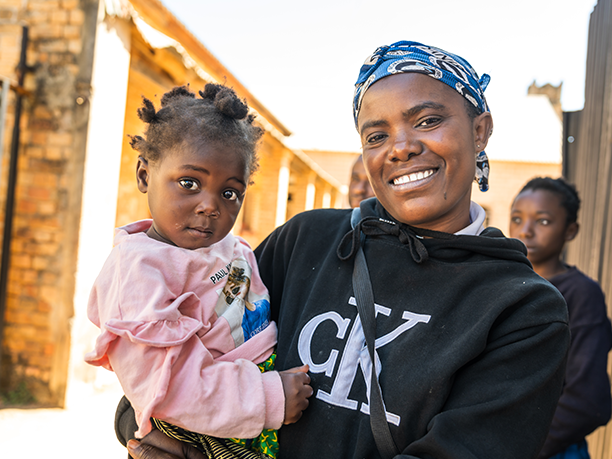
In the rural town of Mpika, Zambia, Sharon and her husband Victor grow maize to feed their four children. When extreme weather like drought hits, its farming families who feel it first—and hardest.
Donate Now
Sowing Seeds of Hope in Mpika
Sharon and Victor are a family of six, with children aged from 3 to 17 years, living in the Diocese of Mpika, Zambia. After heavy rainfall destroyed their traditional hut last year, leaving them with nothing, the family now lives in a house generously provided by a friend.
“We felt bad when it happened,” shared Sharon. “We managed to remove some things because we were around when it was raining. We accepted everything because it was nature that destroyed our house.”
Currently, the family grows vegetables and maize on their quarter hectare parcel of land. Their survival depends on a mix of selling some of their crops to obtain basic necessities, and feeding their family with the rest. However, even with farming, they do not have enough food for the whole year, with their harvest lasting them only eight months. Sharon does her best to stretch what they have to ensure there is always something to provide, even if it is just a little.
“What makes me happy in life is that my wife knows how to manage the little things that we have, she doesn’t misuse things, she makes sure that everyone is taken care of using the same small things,” Victor said.
But with the loss of their house, their eldest child hoping to go to university, and the current economic situation, it has become difficult for the family to keep living on their limited resources.
“Things have really become hard here, people are failing to support their families,” added Victor in despair.
“Your hands are tied, you have got nowhere to get the money from and when you try to think about your life, you can tell that there is no light at the end of the tunnel, because if I can be struggling now, what about in the future? It means my family will continue living in poverty and in sorrow, there is no progress.”
But through the Maize Mill Project, there is finally hope at the end of the tunnel, giving Victor’s family the opportunity not just to survive, but to thrive.
By providing women in the community with seeds, fertilisers and increased agricultural knowledge, they now have a real opportunity to generate a sustainable income and lift their families out of poverty.
In partnership with the local chiefs, more land is being made accessible to women for growing maize and other crops – a meaningful opportunity to expand production and be able to provide for their families.
When Sharon was invited to be part of this women’s collective, her response was filled with hope and joy.
“If they give us all that? It’s symbolising progress and blessings,” she said.
“We have started molding bricks for our new house…that would be our greatest motivation to work very hard if we were given that opportunity to receive the farming inputs.”
Victor agreed, saying it was a “blessing” for Sharon to be in this organisation.