
Latest News
All the Latest News from Catholic Mission around the world.
Based on the model of Jesus, through Scripture and tradition, the Social Doctrine of the Church, more commonly known as Catholic Social Teaching, has developed over the past 2000 years. In modern times we can refer to Rerum Novarum as a key document that set the Church on the path to addressing the most urgent needs of people suffering injustice. Since then various Popes, and many others, have amplified and nuanced Catholic Social Teaching to continually both address the needs of their time as well as implore Catholics, and all people of good will, to use them as a guide to redress injustices in their local context.
As noted from the Second Vatican Council: In any case, “no one is permitted to identify the authority of the Church exclusively with their own opinion”; believers should rather “try to guide each other by sincere dialogue in a spirit of mutual charity and with anxious interest above all in the common good” Second Vatican Ecumenical Council, Pastoral Constitution Gaudium et Spes, 43: AAS 58 (1966), 1063.
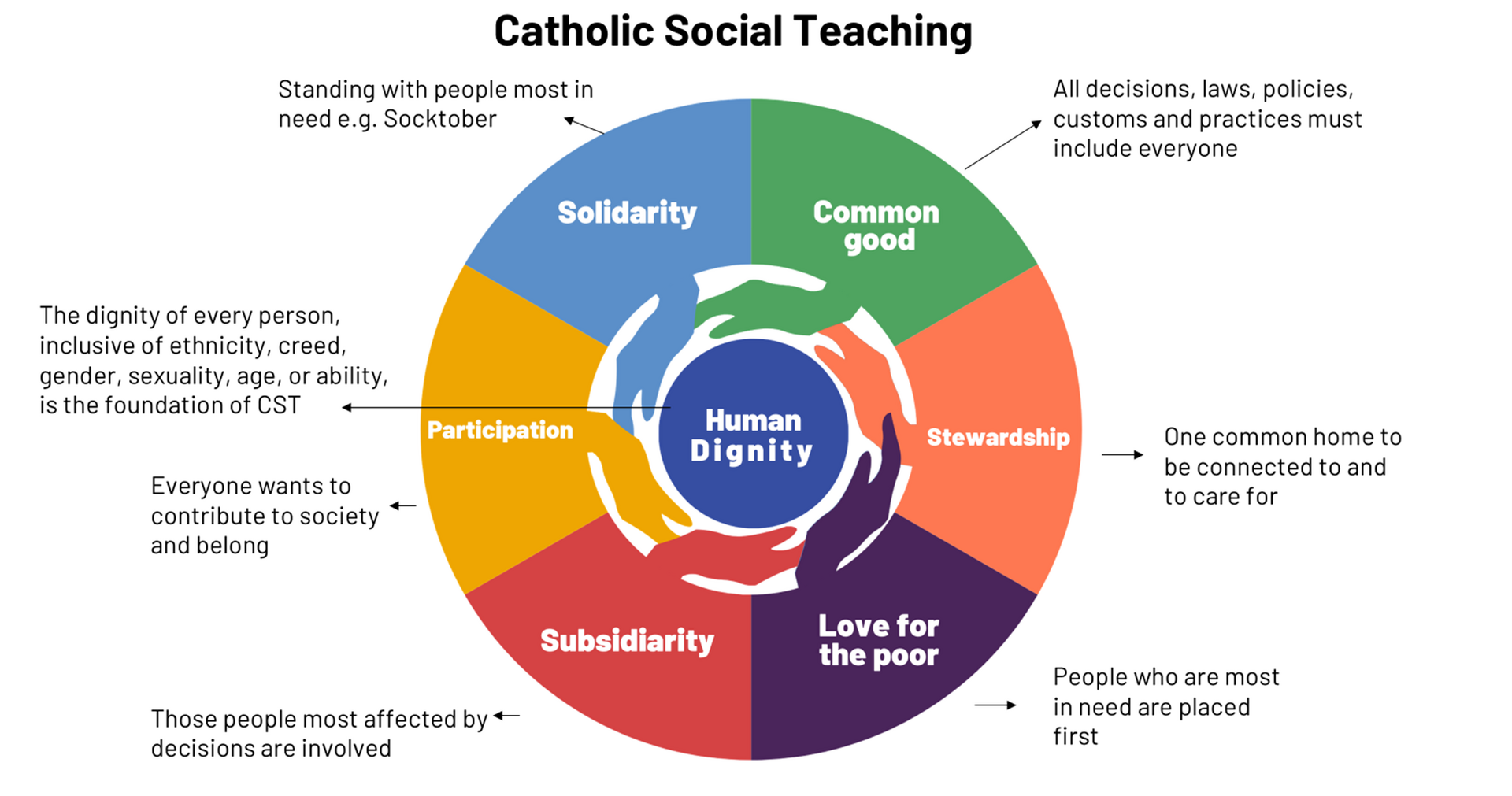
The Catholic Social Teachings (CSTs) provide us with a framework for living God’s mission daily, locally, nationally and globally. There are many ways to describe and articulate the CSTs - Catholic Mission offers the following as a means to make the CSTs accessible, understood and easy to apply.
The dignity of every person is inherent from birth and can never be taken away or diminished. This is inclusive of each person’s ethnicity, gender, sexuality, age, religion, spirituality or ability and is the foundation of CST. Whenever possible we must care for and challenge the injustices of people’s dignity being compromised in anyway.
"So God created man and woman in God’s own image, in God’s image God created them; male and female he created them." (Genesis 1:27)
"Friends, I want to be clear with you, for you are allergic to falsity and empty words: in the Church, there is room for everyone. Everyone. In the Church, no one is left out or left over. There is room for everyone. Just the way we are. Everyone. Jesus says this clearly." (Pope Francis)
The common good refers to each person working together to ensure the creation of a society worthy of its name. People living in minority world countries have a responsibility to consider their own rights, freedoms, choices and way of life and how that can be shared by everyone. Any decision-making process must have at the centre the needs of people who are most vulnerable.
"...Make my joy complete: be of the same mind, having the same love, being in full accord and of one mind. Do nothing from selfish ambition or conceit, but in humility regard others as better than yourselves. Let each of you look not to your own interests, but to the interests of others. Let the same mind be in you that was in Christ Jesus..." (Philippians 2:2-5)
"The parable (Good Samaritan) shows us how a community can be rebuilt by men and women who identify with the vulnerability of others, who reject the creation of a society of exclusion, and act instead as neighbours, lifting up and rehabilitating the fallen for the sake of the common good." (Pope Francis)
We live as one human family on one common home. We are called to respect God’s gift of creation realising ‘we are part of nature, included in it and can never be separated from it’ (LS) and from this place of awareness find ways to live in harmony as one creation, with humility, restraint and awareness of our impacts. We know that the ‘cry of the earth’ and ‘the cry of those rendered poor’ are one cry. People living in the poorest communities are most affected by changes to the earth often caused by wealthier nations. The challenge for each of us is to reflect on our own contribution to co-creating a better world with God, starting from our own local communities.
"And God saw everything that God had made, and behold, it was very good." (Genesis 1:31)
"I ask everyone to accompany this pilgrimage of reconciliation with the world that is our home and to help make it more beautiful, because that commitment has to do with our personal dignity and highest values." (Pope Francis)
Choosing first the needs and considerations of people who are poor is the responsibility of all of us. Preferential love should be shown to people living in poverty and lacking the basic needs to live life to the full as God intended.
"For I was hungry and you gave me food, I was thirsty and you gave me drink, I was a stranger and you welcomed me, I was naked and you clothed me, I was sick and you visited me, I was in prison and you came to me." (Matthew 25:35 - 36)
"He asks us not to decide who is close enough to be our neighbour, but rather that we ourselves become neighbours to all." (Pope Francis)
Each person and every community have the inherent right to participate in decision making processes that directly affect and impact their ability to live life to the full. Subsidiarity requires that all programs, policies, procedures, frameworks and structures being considered and developed must have people most affected at the table.
"You shall love the Lord your God with all your heart, and with all your soul, and with all your strength, and with all your mind; and your neighbour as yourself." (Luke 10:27)
"Today, in a world torn apart by divisions and conflicts, Christ’s Gospel remains the gentle yet firm voice that calls individuals to encounter one another, to recognize that they are brothers and sisters, and to rejoice in harmony amid diversity." (Pope Francis)
We all are part of, and belong to, one human family living on one common home. Each person is significant inclusive of their national, religious, ethnic, economic, political, and ideological differences. Each person must be a voice for, and stand with people, and communities who are most vulnerable locally and globally.
"There is no longer Jew or Greek, there is no longer slave or free, there is no longer male and female; for all of you are one in Christ Jesus." (Galatians 3:28)
"While we are all fragile and in need, the Gospel’s compassionate outlook leads us to see the needs of the most vulnerable…Let us also remember not to differentiate between them, since we Christians can never express preferences when faced with those in need who knock at our door: fellow citizens or foreigners, those belonging to one group or another, young or old, likeable or disagreeable, and so on." (Pope Francis)