

Hope Exhibition
To celebrate 100 years of World Mission Sunday, Catholic Mission invites you to experience Hope, a unique photography exhibition capturing moments of hope, connection and encounter shared with communities around the world.
From Our Archives
Bright colours, bold designs and an invitation that has travelled across generations.
For a century, World Mission Sunday has brought Australians together in prayer, generosity and solidarity with communities around the world.
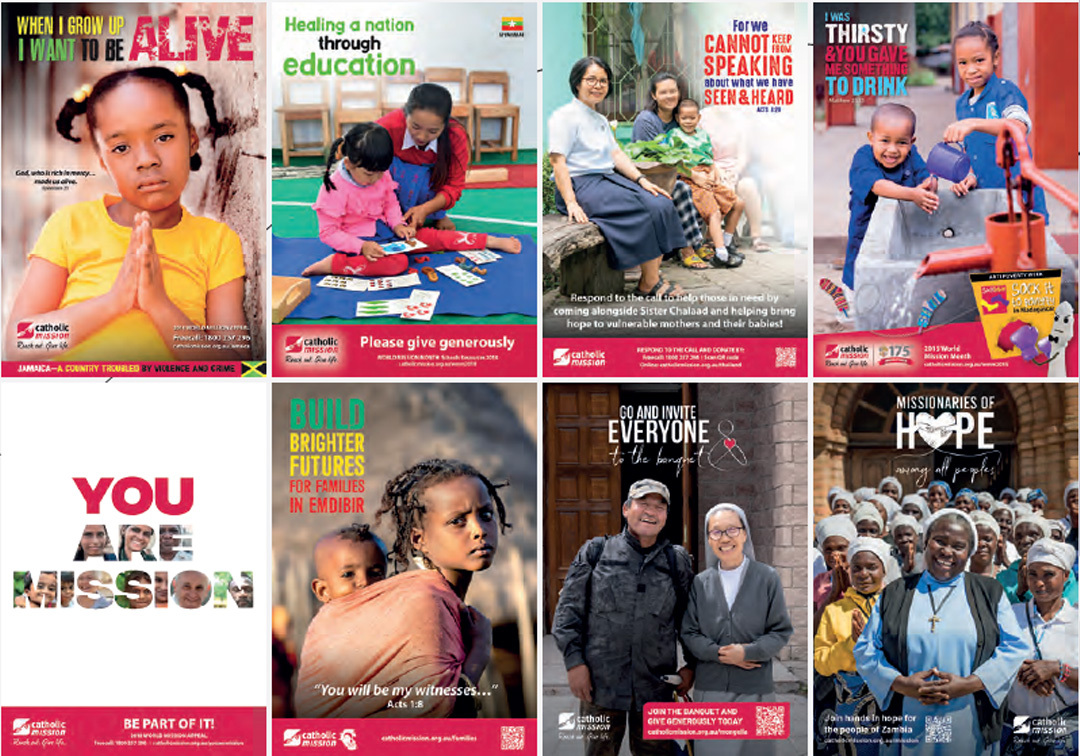
From radio broadcasts and cardboard donation boxes to colourful posters and powerful photographs, Catholic Mission's archives reveal some surprising ways this invitation has been shared.
Take a journey through the decades and discover the stories behind the posters.
1937 - 1951 | Before social media, there was radio, cinema and a little creativity!
In 1937, questionnaires sent across Australia revealed an impressive level of participation in the World Mission Sunday appeal. According to the records, every parish participated, with the exception of Port Augusta.
An early glimpse of just how far the missionary spirit had spread across the country.
Long before social media, Catholic Mission was finding creative ways to reach Australians.
In 1940, 14 radio stations across Queensland, New South Wales, Victoria and Western Australia broadcast World Mission Sunday announcements. Meanwhile, 2,500 posters were distributed to churches, and priests received resources to help share the message.
Back then, the Society for the Propagation of the Faith operated through a membership subscription system, a model no longer used today. By 1940, it counted an impressive 149,726 members across Australia, with membership doubling in just two years.
In 1941, cinema became another way of bringing mission stories to Australian audiences.
A film titled Black Gold was used to promote missionary work in Brisbane, Sydney, Melbourne and Wagga Wagga, with two further films reportedly in production.
That same year, the St Vincent de Paul Society joined efforts to help extend the work of the missions across Australian dioceses.
Who said mission couldn't have a soundtrack?
In 1942, the Therry Society recorded two songs, Xavier Road and Salt of Solomon, which were played on radio. Following World Mission Sunday, 28 radio stations also broadcast commentaries from diocesan directors across Australia.
The archives record another familiar innovation that year: the appearance of cardboard donation boxes known as Mission Banks.
Perhaps you remember collecting coins in one at school or in your parish?
In the early 1950s, World Mission Sunday posters continued to place a strong emphasis on the Society for the Propagation of the Faith. At the time, the Society operated through a membership structure, with its own dedicated day in February. These posters offer a glimpse into an era when belonging to the Society was an important way for Australian Catholics to participate in the Church's missionary work.
In 1951, Catholic Missions magazine reminded Australians that no contribution was too small to make a difference. Whether through prayer, personal service or financial support, every act of generosity mattered. The article highlighted how thousands of individual contributions came together to support missionary communities around the world. It also encouraged Catholics to dedicate World Mission Sunday to prayer, reminding readers that supporting mission was about much more than giving money.
1963–1980 | New perspectives, new imagery and a renewed call to action.
The Vatican's online archives preserve World Mission Sunday messages from Pope Paul VI dating back to 1963.
These annual messages offer a fascinating glimpse into how successive Popes have invited Catholics to reflect on mission, responding to the challenges and opportunities of their time.
While not every message is available in the online collection, those preserved help trace the evolving language of mission across the decades.
In 1964, Catholic Missions offered Australians a glimpse into missionary life in New Guinea, where reaching remote communities could mean walking for weeks, travelling by boat or relying on small aircraft to deliver essential supplies.
The October edition followed the work of the Passionists in Vanimo, highlighting the challenges of establishing schools, supporting local communities and reaching isolated villages.
Meanwhile, the World Mission Sunday editorial reminded Australians that mission was everyone's responsibility, describing supporters at home as the 'HOME FRONT', borrowing language familiar from the war years.
While the language has changed over the decades, the invitation remains the same: everyone has a part to play in mission, whether through prayer, generosity or service.
In 1967, Australians were invited to put their missionary spirit into action with a series of practical suggestions under the heading 'Why Not…?'
Teenagers were encouraged to donate the price of a record to young people experiencing hunger overseas. Parents were invited to teach their children to share, teachers to organise fundraising projects, and businesspeople to share some of their profits.
The message was clear: whatever your age or occupation, there was a way to contribute.
The 1967 campaign also featured Fr Pierre Ceyrac SJ, a French Jesuit missionary whose extraordinary life would take him from communities experiencing poverty in India to refugee camps along the Thai-Cambodian border. His conviction was simple: 'You have to bring hope.'
Discover the story of Fr Pierre CeyracIn his message for World Mission Sunday on 20 October 1968, Pope Paul VI reminded Catholics that mission was not the responsibility of a select few.
The call belonged to every believer and every community, reflecting the renewed emphasis on the missionary nature of the whole Church following the Second Vatican Council.
An invitation that continues to resonate today.
In 1969, the pages of Catholic Missions drew attention to the unequal distribution of global wealth, highlighting an estimate that 15 per cent of humanity held 85 per cent of the world's income.
The discussion reflected growing attention to social and economic inequalities and the responsibility of Christians to share resources more fairly.
Mission was being presented not only as a matter of faith, but also as a call to solidarity and justice.
Nearly a decade after the conclusion of the Second Vatican Council, Pope Paul VI placed reconciliation, justice and authentic Christian witness at the heart of his World Mission Sunday message. He reminded Catholics that living the Gospel must come before proclaiming it. His message also acknowledged the need to confront failures of justice and charity, inviting Christians to seek reconciliation across differences of race, language and culture. A powerful reminder that mission begins with how we live and treat one another.
In August 1980, just days after Vanuatu declared independence, Bishop Francis Lambert SM wrote to Australian Catholics with a message of gratitude and hope. Their generosity was helping support the formation of catechists and the development of the Mission Station of Melsisi on Pentecost Island. As Vanuatu entered a new chapter, Bishop Lambert asked Australians to continue praying for its people as they emerged as a new nation.
Beyond the poster: A story still unfolding
More than four decades later, Melsisi continues its journey of faith and resilience. After Tropical Cyclone Harold devastated the mission station in 2020, the community began rebuilding its schools, hospital and church.
The story connects an appeal from 1980 with a community whose mission continues today.
1985–2000 | From catchy slogans to a name Australians know today.
In 1985, the Pontifical Mission Aid Societies were considering a new identity. Internal records reveal that the organisation's name was seen as outdated and poorly understood by the Australian public. A proposal to adopt a new name was being prepared for consideration by the Australian bishops, marking an early step towards a more accessible identity. Meanwhile, the invitation to Australians remained simple and memorable: 'A cent each day as well as pray', encouraging people to make prayer and generosity part of their everyday lives.
More than a decade after discussions began about adopting a name that would resonate better with Australians, the earliest poster identified in our archival collection featuring the name Catholic Mission dates to 1997.
That year also marked the 175th anniversary of the Society for the Propagation of the Faith, founded by Blessed Pauline Jaricot in Lyon, France, in 1822.
The poster reflects the organisation's evolving identity, while celebrating its longstanding commitment to connecting Australians with the universal Church's mission.
At the turn of the millennium, the World Mission Sunday poster featured two smiling children looking directly at the camera. Compared with some of the more illustrative designs of earlier decades, this photographic approach placed people and their expressions at the heart of the campaign. A simple image that invited Australians to connect with the communities behind the appeal.
2013–2023 | Stories of faith, solidarity and hope across the world.
In his first World Mission Sunday message as Pope, Francis reminded Catholics that sharing the Gospel is an essential part of Christian life.
His message emphasised the importance of faith, encounter and the responsibility of every baptised person to participate in mission.
A new pontificate, carrying forward an invitation shared across generations.
Celebrated during the Extraordinary Jubilee of Mercy, World Mission Sunday 2016 brought a particular focus to compassion and the maternal mercy of God.
Pope Francis invited Catholics to recognise mission as an expression of God's love, made visible through service, encounter and care for others.
Three simple words carried a powerful message in 2018: 'You are Mission'. In a year when Pope Francis placed particular emphasis on young people, the invitation reminded Catholics that mission is not something reserved for others or for another time. Everyone has a role to play, and young people have a unique contribution to make.
In 2019, Catholic Mission's World Mission Sunday appeal turned attention to communities in India. Through stories and photographs, Australians were invited to learn about the life of the local Church and stand alongside communities through prayer and practical support. The campaign continued a longstanding tradition of connecting Australian Catholics with the hopes and challenges of communities overseas.
In 2020, as the world faced the COVID-19 pandemic, Catholic Mission's World Mission Sunday appeal focused on Cambodia. Pope Francis' message that year asked, 'Whom shall I send?', inviting Catholics to respond with generosity even amid uncertainty. At a time of global disruption, the invitation to remain connected through faith, prayer and solidarity took on renewed significance.
In 2023, World Mission Sunday took Australians to Mongolia, where the local Catholic Church continues to grow and serve its communities. Inspired by Pope Francis' theme 'Hearts on fire, feet on the move', the campaign celebrated the missionary spirit expressed through encounter, service and walking alongside others. It was also the year Pope Francis made his historic visit to Mongolia, drawing international attention to one of the world's smallest Catholic communities.
Across the decades, the posters, slogans and ways of reaching people have changed. Radio broadcasts have given way to digital campaigns, illustrations to photography, and cardboard donation boxes to new ways of giving.
Yet, at the heart of World Mission Sunday, the invitation remains the same: to look beyond ourselves, encounter others and put faith into action.
As we celebrate 100 years of World Mission Sunday in 2026, these archives remind us that mission has always been shaped by the people who respond to that invitation.
Discover more stories of faith, encounter and hope through the Hope exhibition.

